Section Discussing multiple options for refining the order of the paradigms in physics courses
The first Upper Division Curriculum Committee meeting during spring term opened with the Paradigms 2.0 Committee members reporting their findings from the student focus group. Next one of the associate professors presented a revised rationale for making refinements and five proposals: a minimal change, a medium change, and now three options for a large change in the order of the upper level courses. This meeting provided time for an open discussion of these options in preparation for a vote at the regular faculty meeting two days later.
Summarizing the rationale for refining the order of the paradigms in physics courses.
The revised handout listed the problems identified, trade-offs in new proposals, questions, and a transition plan. The problems were now numbered and those agreed upon by the students were also indicated as shown below.
Problems identified.
- There is still a junior year brick wall (especially for transfer students)
- PH 315 and 335 are very successful intro for students on sequence (would like all students to have them before Paradigms [Students agree]
- Hard teaching two populations in PH 315 (also PH 335) [Students agree]
- Students taking PH 315 alongside PH 212 are underprepared [Students agree]
- Want room in schedule for new upper division lab
- Enrollment in PH 315 is unsustainably high (also other courses, but less so)
- PH 422 would be better earlier:
- Needs to be after vector calculus (which is no longer reliably taught in the Fall)
- Intro to power series, visualization with Mathematica, etc., help other Paradigms
- Pairs well with PH 365 for introducing computation and visualization
- Still want maximal content prior to GRE Physics exam [Can 315 cover enough thermal?]
- Want lighter Spring Junior schedule to give students time to start research
- [Students say] E&M Capstone is really hard and should not go with two Paradigms.
- [Students say] Heavy Senior Fall may conflict with course sequences in other major.
- The project in Periodic Systems should precede the project in the E&M Capstone
Trade-offs in new proposals.
- PH 424 introduces Fourier series towards end, PH 427 introduces Fourier Transforms towards beginning, ideally these should sequence.
- PH 424 with its lab report could benefit from running for 10 weeks.
- PH 426 introduces Legendre polynomials, which could precede Fourier series, but have never done so and rely on closely related basis set reasoning.
Questions.
- Which of the two new options (or an older one)?
- How will this interface with grad courses taken by undergrads?
- How will this work for grad students taking undergrad courses?
Transition plan.
- Skip PH 423 next year (What to do with those who failed it this year?)
- Teach PH 315 twice starting next year.
- Convert PH 424 or PH 426 to be taught in 10 weeks (requires coordinating math content)
Presenting the current order as well as proposing and discussing a minimal change.
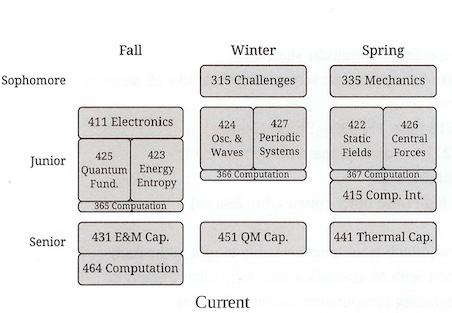
Next the associate professor presented the current order of the sophomore, junior, and senior courses and the proposed minimal change as shown in Figure 1. The wide boxes represented 10-week courses. The very thin but wide box represented a series of 1-credit computational physics courses taught in contexts that matched the associated paradigms in physics courses. Each set of two boxes side-by-side represented a series of two 5-week paradigms in physics courses. Not shown are the introductory physics sequence and senior year electives such as specialty courses.
A white background in the diagram representing a minimal change indicates courses that were added to or changed in position from the current line-up. PH 422, Static Fields, for example, is shown as shifted from spring term back to the prior position it had had as the first paradigm during fall term before the major changes in instruction approved in 2016 were made. PH 423, Energy and Entropy, is shown as shifted from fall term to spring. Also added would be a second section of PH 315 spring term as well as an upper division lab (yet to be developed) or a computer interfacing course, both of which students could enroll in either as juniors or seniors.
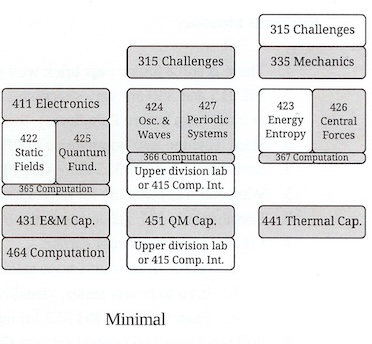
This minimal change would address issues 4 (providing a second section of PH 315 spring term for students completing PH 213 winter term), 5 (including an upper division lab in the schedule), and 7b and 7c (returning PH 422 to its former position as an early paradigm in physics course). It would be worse for transfer students but the order of presenting content would improve.
Proposing and discussing a medium change.
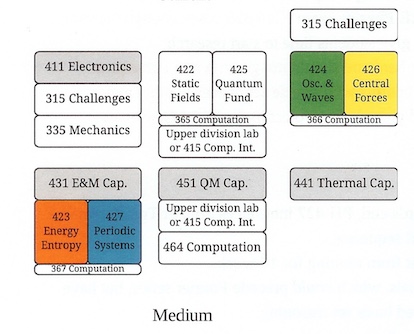
Next presented was a medium change with PH 315 and PH 335 both now to be offered fall term, still as 10-week courses, as shown in Figure 2. This change would shift all the junior-level paradigms in physics courses by one term.
The first two paradigms in physics courses, PH 422, Static Fields and PH 425, Quantum Fundamentals, shown with white backgrounds, would be in the same order as shown in the minimal change, although during winter rather than fall term. The four other junior-level paradigms in physics courses were shown each with its own color to aid in keeping track of its position in the three major change options shown below.
The shift of the paradigms courses by one term pushed two paradigms into fall of the senior year (PH 423 Energy and Entropy, and PH 427 Periodic Systems). Each would be a 5-week course meeting daily, teamed with the 10-week PH 431, Electricity and Magnetism Capstone, meeting Mondays, Wednesdays, and Fridays. This option addressed issues 1 through 7 as well as 9 and had been the option preferred in the straw vote taken at last Upper Division Curriculum Committee meeting winter term. It featured a lighter spring load but heavy senior fall with all courses in their current formats. The students participating in the focus group, however, stated that the electricity and magnetism capstone was a very hard course and should not be offered in the same term as two paradigms in physics courses. Also this might make it hard to take courses in other departments for minors.
Transition plan.
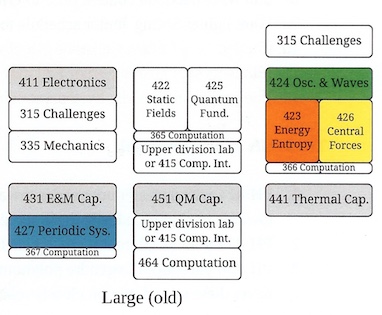
The first option for a large change was the initial one that had been proposed earlier, as shown in Figure 3. This option avoided teaming two paradigms with a capstone course in the fall of the senior year and moved one paradigms course, PH 423 Energy and Entropy, back to spring of the junior year. One of the three paradigms courses during spring term would be a 10-week course, PH 424 Oscillations and Waves; the other two would be a series of two 5-week courses. The fall paradigms course, PH 427 Periodic Systems, also would become a 10-week course to match the format of the capstone course, PH 431. This option addressed issues 1 through 8 but not 9, having a light spring schedule so students could get started on their research for their senior thesis. This also would shift two paradigms in physics courses into the more traditional 10-week schedule.
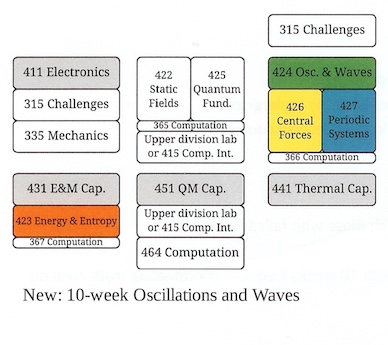
The second option for a large change, shown in Figure 4, had a similar format but changed which paradigms in physics course would be taught in fall of the senior year, PH 423 Energy and Entropy along with the PH 431 Electricity and Magnetism Capstone, rather than PH 427, Periodic Systems. This prompted concern about whether the students heading to graduate school would know enough about thermodynamics before taking the graduate record examination (GRE) as seniors early in the fall term. A discussion ensued about the thermal topics included in the new Physics 315 course and to what extent that course could provide enough preparation for the GRE.
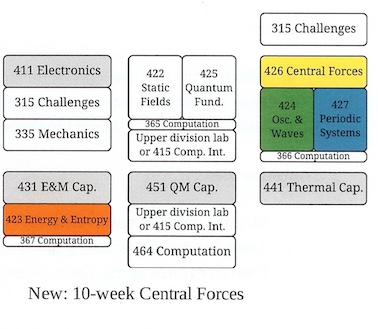
The third option for a large change, shown in Figure 5, in the order of the upper-level courses kept the same format as option 2 except for making PH 426 Central Forces into the 10-week course during spring term rather than PH 424 Oscillations and Waves. The difference between these courses was in whether they had labs that needed 5-week format with the two-hour Tuesday/Thursday sessions.
Discussions of the advantages and disadvantages of these options continued throughout the time available for this meeting. Presenting the options for a vote would occur two days later, at the first regular faculty meeting during spring term.

