As part of the Paradigms redesign process, we are seeking feedback from faculty, students, and alumni of the physics department. This feedback will help us to understand the needed scope of the redesign and what aspects of the current curriculum should be preserved or adjusted. A team of four faculty members (Corinne Manogue, Ethan Minot, David Roundy and Liz Gire) will use the feedback from this survey and also from discussions with curriculum groups and research groups to construct an initial proposal. We will then seek your individual input again to refine and polish the proposed redesign. Our intent is that the resulting program will incorporate the goals and needs of the whole department.
The university’s IRB office has asked us to include the following message:
You previously participated in the Paradigms in Physics (funded by the NSF) research study. We are now asking you to complete a survey to help us revise the Paradigms in Physics curriculum. The survey will take 30-45 min. Participation is voluntary. Your decision not to participate will not affect your employment. If you have any questions about this survey, please contact Emily van Zee, senior researcher, at vanzeee@science.oregonstate.edu. The security and confidentiality of the information collected from you online cannot be guaranteed. Confidentiality will be kept to the extent permitted by the technology being used. Information collected online can be intercepted, corrupted, lost, destroyed, arrive late or incomplete, or contain viruses.
Please answer each question. If you require more space to convey your ideas, please feel free to attach additional pages or e-mail overflow text to Emily van Zee at vanzeee@sicnce.oregonstate.edu.
Are you:
Tenured Faculty
Tenure-Line Faculty (pre-tenure)
an Instructor
a TA (or have been) for paradigms courses
a TA (or have been) for other non-paradigms courses
a graduate student who has not TA’d
a graduate of the Paradigms in Physics program
other _____ _____ _____ _____ _____ _____ _____ ___
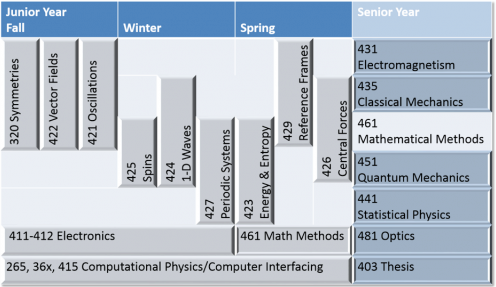
The current curriculum is shown below. The junior year paradigms courses are arranged to indicate the subject matter preparation they provide for the senior year capstone courses listed in the column on the right. Symmetries, for example, primarily draws on topics in electromagnetism, classical mechanics, and math methods. Information about the courses can be found at: http://catalog.oregonstate.edu/CourseList.aspx?subjectcode=PH&level=undergrad&campus=corvallis 1
Figure16.Junior and senior year courses for physics majors. Please indicate which undergraduate courses you have taught, served as a TA, and/or completed as a student
314 Modern Physics
320 Symmetries
421 Oscillations
422 Vector Fields
423 Energy & Entropy
424 Waves
425 Spins
426 Central Forces
427 Periodic Systems
429 Reference Frames
461 Math Methods
403 Thesis
411 Electronics
412 Electronics
415 Computer Interfacing & Instrumentation
431 E&M Capstone
435 Classical Mechanics Capstone
441 Thermo Capstone
451 Quantum Capstone
481 Optics
365 Applications of Computation I
366 Application of Computation II
367 Applications of Computation III
482 Optical Electronic Systems
483 Guided Wave Optics
495 Particle & Nuclear
499 Special Topics
What do you think should be the primary goals of the upper division physics courses?
What goals are not being adequately addressed?
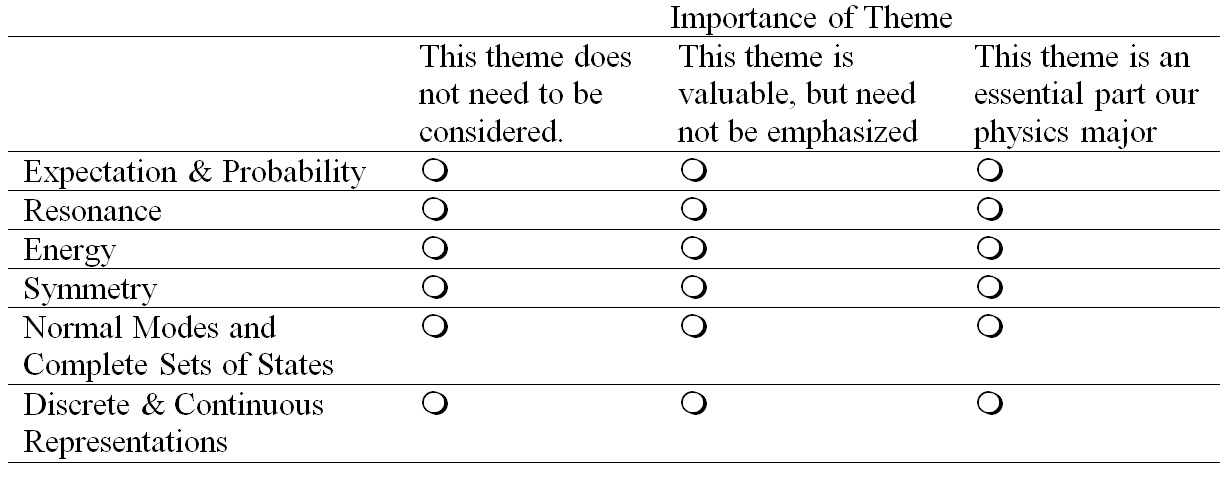
Through a long process of “card sorting,” the faculty organized the upper level curriculum to help students learn to think like physicists in multiple contexts. The junior level “paradigm” courses explore concepts such as central forces that are common to a variety of fields in physics. The senior level “capstone” courses focus on developing in depth understanding of traditional topics such as classical mechanics, electricity and magnetism, quantum mechanics, thermal dynamics and statistical physics, and mathematical methods. The faculty designed this upper level program to develop themes gradually cross the junior and senior level courses. Please rate the importance of the following themes.
Figure17.Form 1. Please add any other themes you’d like to see addressed and rate each theme as “valuable” (but not emphasized) or “essential”.
What content and other knowledge/skills are necessary to prepare students to do research in your field? Are these addressed adequately in the current curriculum?
What aspects of the current junior and senior year program do you think should be preserved?
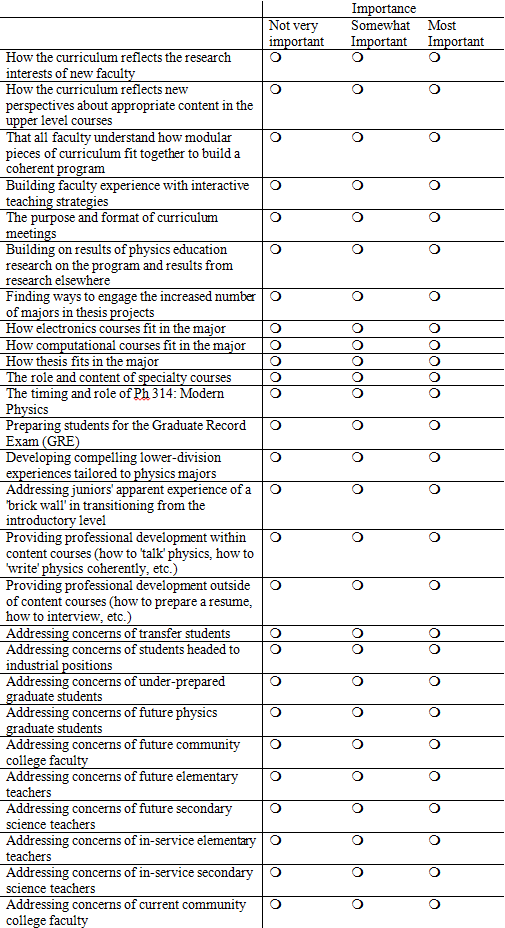
Here are some of the issues/needs of which we are aware. Please rate the importance of each issue.
Figure18.Form 2.
Please add and rate the importance of any additional issues of which you are aware.
provides a wide variety of resources for faculty interested in learning more about the Paradigms in Physics program. What other support, if any, would you like for enhancing your understanding of the curriculum and of active engagement teaching strategies?
Additional comments about the program for physics majors as a whole.