Section Presenting the options for a faculty vote
The regular faculty meeting began with one of the associate professors summarizing the rationale for making refinements in the order of the various upper level courses. Next presented were the current order of the courses, a minimal change, a medium change, and three options for major changes.
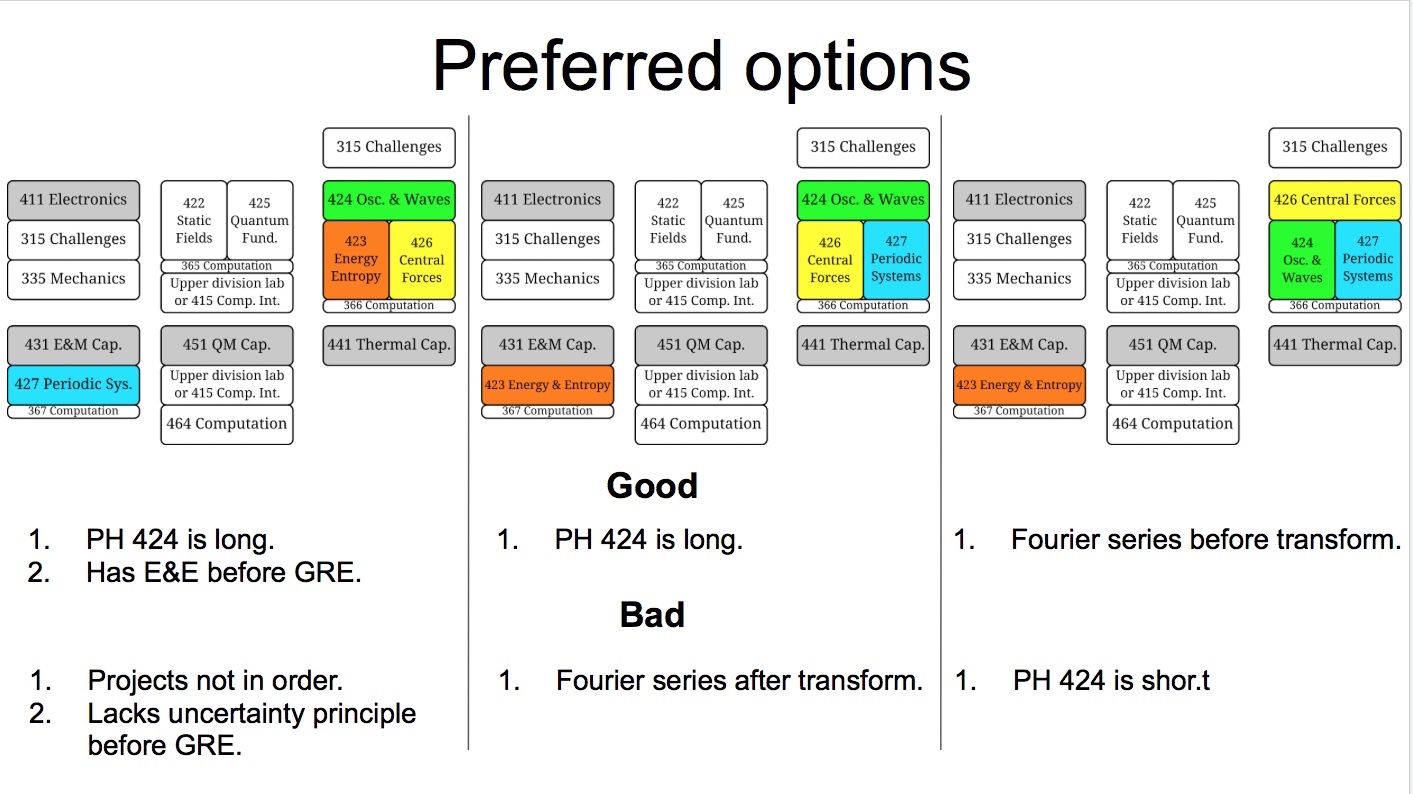
As shown in Figure 6, the three options for a large change were displayed in a row with the most important “good” and “bad” aspects identified for each. The issues included whether one of the paradigms in physics courses, PH 424 Oscillations and Waves, would be offered in the current format meeting daily for 5-weeks (short) or meeting in the traditional MWF format for 10 weeks (long), whether students heading for graduate school would learn about certain topics before the Graduate Record Examination (GRE), whether some mathematics (Fourier series) would be taught before or after related mathematics (Fourier transforms), and whether course projects would be in the appropriate order.
When a formal vote was taken, no one voted for the minimal change or the medium change. Among the three options for a large change, no one was in favor of the first with PH 427 Periodic Systems in the senior year. The only difference between the second and third options for a large change was which of the three paradigms in physics courses would move to a 10-week format, PH 424 Oscillations and Waves or PH 426 Central Forces. It was agreed that the faculty members teaching the three junior spring term courses could collaborate in making that decision as well as any shifting of content among these courses as needed. As the meeting came to a close, an energetic conversation began among these faculty members about ways to do just that!