Section 5.1 Continuing to Engage Faculty in Collaboratively Discussing and Developing Plans
The Upper-Division Curriculum Committee continued meeting every three weeks during the 2016-2017 academic year. This committee had been meeting regularly since the initial design of the paradigms in physics courses two decades earlier. Members included faculty who were teaching junior and senior level physics courses. The purpose of the committee was and is to provide a forum within which upper-division faculty can discuss and continue refining their students' learning experiences. During 2016-2017, the meetings provided a way to continue engaging the upper-division faculty in collaboratively discussing and developing the plans to re-envision the upper-division curriculum.
One meeting during Fall 2016, for example, focused upon identifying synergies among the upper division courses, ways in which the new versions of the courses would be connected and building upon one another. As noted in Appendix A, this was an effort to revisit the process through which the original designers of the Paradigms in Physics curriculum had identified six common themes and traced the development of those themes throughout the upper-division courses. During this meeting, the faculty thought about the role each course would play in developing students' knowledge and skills in three areas: professional communication, physics conceptual ideas, and professional practices. As the group brainstormed what these might be, various aspects were written on the wall-sized white board as shown in Figure 5.1.1.
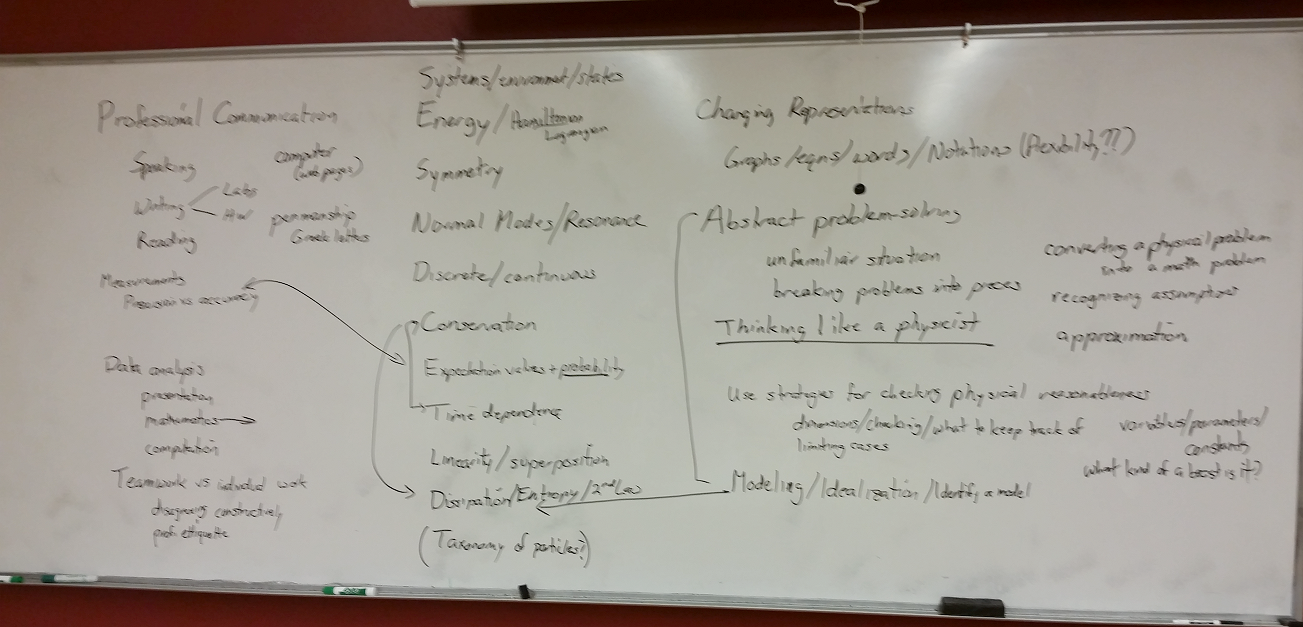
In which courses, for example, would the students be learning how to write scientifically? Where would they learn about systems, a theme not mentioned in the original set? How would they learn to be comfortable facing an unfamiliar situation, that is, to be able to handle something different and to make abstractions through concepts with which they are familiar, a practice expected of physicists? During another fall Upper Division Curriculum Committee meeting, the group discussed more immediate issues such as plans for the new sophomore course to be offered winter term, the role of teaching assistants in active engagement courses, changes in the electronics course, and ways to accommodate the increasing number of students in labs.
During Winter 2017, one of the Upper Division Curriculum Committee meetings again focused on articulating connections among the courses by focusing upon one subject matter area. They brainstormed ways in which quantum mechanics content would move through the upper-division courses, starting with the new sophomore courses, during four of the revised junior-level courses, and finally in the senior capstones. Again a general brainstorming of thoughts was documented by writing on the wall-sized white board various aspects that would appear in each course as shown in Figure 5.1.2.

During another winter Upper Division Curriculum Committee meeting, two faculty members discussed the challenges that they had encountered as well as what had gone well in integrating labs in the new winter sophomore course and one of the junior-level courses. The professor integrating math bits provided a handout documenting what topics were being included in which of the six revised junior-level courses.
At an upper-division curriculum meeting during Spring 2017, the faculty member who had taught the second winter paradigms in physics course presented a thorough reflection on the experience of combining two courses. Noted were the new order of topics, topics added and removed, topics students seemed to like and not like, some of their conceptual difficulties, what worked and what not, and recommendations for changes, particularly with the labs. During another meeting spring term, another faculty member facilitated a discussion about changes needed in the paradigms wiki to help new faculty and others interested to use this resource more effectively.
Although the focus of each meeting changed, this process of meeting regularly contributed to the collaborative environment in which faculty engaged in on-going efforts to enhance their students' learning.