
Section 4.1 Goals of the new Physics of Contemporary Challenges course
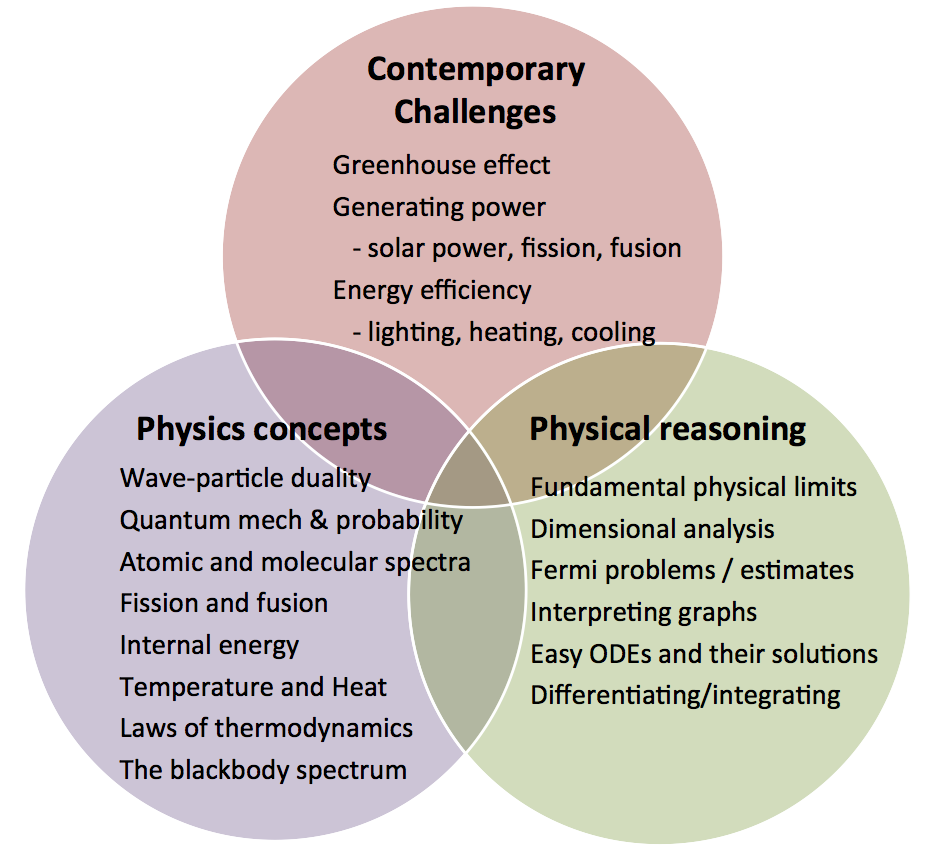
In describing the course for a proposal, the faculty member designing the course wrote:
Climate change and renewable energy are major contemporary challenges. Students are inspired to engage with these challenges, and physics will play a critical role in addressing these challenges. However, students in introductory physics classes have no formal interaction with such challenges. To broaden participation in physics, we propose a course that uses contemporary challenges as the central theme. The course will be positioned early in the physics major. The challenges theme will motivate the introduction of quantum mechanics and thermal physics concepts, as well as the development of physical reasoning skills. The course will be taught using active engagement strategies, based on expertise our department has developed for the Paradigms in Physics upper-division curriculum. Labs will be integrated into lectures. For example, students will use minimalistic equipment (chosen for conceptual simplicity) to see the discrete spectra from a hydrogen lamp, and estimate Planck's constant from the turn-on voltage of red, green and blue LEDs. The course will cover content that is often delivered using the historical narrative of 20th century physics. We propose to replace this historical narrative with a forward-looking narrative. We hypothesize that a forward-looking narrative will attract a wider cross-section of participants to physics. The change will also create space in the curriculum for the development of physical reasoning skills, and engaging discussion of the role physics plays in contemporary society. The emphasis on an expanded set of reasoning skills, and new perspectives, will strengthen the connection between lower and upper division physics classes.