
Section 2.3 Paradigms in Physics 2.0
In 2016, the Department of Physics at Oregon State University began a process to revise our Paradigms in Physics curriculum for physics majors. We began with a colloquium to inform the department of our plans and request their assistance, followed by a survey of students and faculty as well as individual interviews with the faculty teaching each course. As we developed a plan to address student- and faculty-identified challenges in the curriculum, we met with each faculty member individually to explain and refine our proposal, which was unanimously approved by the faculty. Major changes include major changes to several courses (math methods, computational physics, modern physics, electronics, and classical mechanics), including the introduction of two sophomore-year courses designed specifically to help prepare students for their upper-division courses.
1
The material in this section originally appeared in [23].
Subsection Introduction
The Paradigms in Physics project began in 1996, when three faculty members at Oregon State applied to the NSF for funding to redesign the upper-division curriculum. The motivation for the original Paradigms~1.0 project was in fact similar to the motivation for Paradigms~2.0: a desire to soften the "brick wall" encountered by students upon reaching the junior year, within the constraint that transfer students must be able to graduate with two years of upper-division courses [24]. On top of this, there was a desire to provide students with a broad knowledge of physics prior to the GRE exams in the fall of their senior year. The process of redesigning the curriculum was guided by the creation of index cards listing subject content, and sorting these cards into courses. This process involved the entire faculty, and culminated in a unanimous agreement to adopt the resulting curriculum.
The resulting curriculum was primarily composed of intensive junior-year Paradigm courses, followed by more conventional senior-year courses. The Paradigm courses meet every day for a total of seven hours per week for 3 weeks. These courses incorporate laboratory experiences and active engagement into the class, and typically have two problem sets per week. These courses also had integrated math content, and were followed by a Math Methods course. The senior-year courses are more traditional 3-credit courses which meet three hours per week for an entire 10-week quarter.
Two decades have passed since the original Paradigms~1.0 effort. During this time we have made a number of changes: e.g. a new first Paradigm course was introduced to soften the beginning of the junior year, the order of courses was shuffled more than once, Math Methods was moved from the beginning of the senior year to the end of the junior year, and a computational laboratory course was introduced to accompany the junior-year Paradigm courses. The faculty maintained the tradition of meeting every three weeks to discuss issues relating to upper-division teaching. New faculty arrived and learned to teach the new courses, and introduced their own ideas to the courses.
A number of factors motivated us to embark on the Paradigms~2.0 process. In the last two decades, we have observed a number of challenges students face in our major. While in many cases we addressed these by changing and reordering the courses, we felt a look at the entire curriculum was in order. In addition, our faculty understanding of the details of the sequence was diminishing by attrition: while our younger faculty are enthusiastic about the Paradigms program, many lack perspective on where students are in a given course, and what content is essential for students to grasp for a subsequent course.
Transfer students.
Our curriculum is strongly affected by our desire to accommodate transfer students from community colleges. This leads us to focus on a physics major in which all upper-division courses are taken in two years. However, our current curriculum is very hard on students in the fall of their junior year, and especially so for transfer students. So we aimed to structure and order the courses such that non-transfer students could be better prepared for their junior year, while transfer students could postpone a few courses so that the Fall quarter of their junior year would be no more difficult than that of any other student.
Coupled curricular changes.
A backlog of curricular changes had accumulated that could not be separated from an examination of the curriculum as a whole. The requirements for computational physics, the number of required electronics credits, and the role of our modern physics course could not easily be addressed separately.
New faculty.
Only 5 of our 16 current tenure-line faculty were involved in the original Paradigms~1.0 effort. Some of the newest faculty have only a superficial understanding of our course structure. This poses a challenge when these professors teach courses that are closely intertwined with one another.
Subsection Paradigms 2.0 process
Like the process that led to Paradigms 1.0, the Paradigms 2.0 process is a "shared vision" type of change [25]. Changes to the course structures of the physics curriculum emerged from discussions among the members of the department. We began the Paradigms 2.0 process in the Winter of 2016, having in the previous year obtained faculty agreement, and support from our Department head. The process was spearheaded by a committee of four (the authors DR, EG, EM, and CAM, with EvZ present at meetings documenting our process). During the Winter quarter, we informed the community of our process through a colloquium, and collected student and faculty perspectives on the existing curriculum. We then interviewed faculty who recently taught each of our existing courses to document topics that were currently covered. This resulted in a total of \(\sim\)700 index cards in \(\sim\)30 stacks, with each stack corresponding to one course, and each card describing a topic, color-coded as in Figure 2.1.
The committee met twice a week to discuss existing challenges and sort the cards into new stacks corresponding to new and reordered courses. When we discussed major changes to a course, we often invited interested faculty to join us to provide their own perspective on possible challenges and improvements. Once we had a draft proposal, we began inviting each faculty member in to see the cards and discuss the proposed sequence of courses. In addition, we had a focus group with all the current students to explain the proposed changes and request feedback.
After incorporating the feedback from individual meetings with every faculty member, we scheduled two full faculty meetings with a week in between. In the first meeting, we presented our proposal in detail and invited questions, but not discussion. This was needed for a couple of reasons: those faculty we met with first may not have seen the final proposal, and some faculty during their individual meetings chose to focus on a small subset of the curriculum, often relating to courses they had themselves taught. During the following week faculty engaged in hallway discussions of the proposal. This week helped ensure that the faculty did not feel rushed into a vote. In the second faculty meeting, we again presented our proposal, and opened the floor for discussion. After considerable discussion, largely on changes that were not part of the proposal, the faculty unanimously voted to adopt the proposed changes.
Subsection Changes made
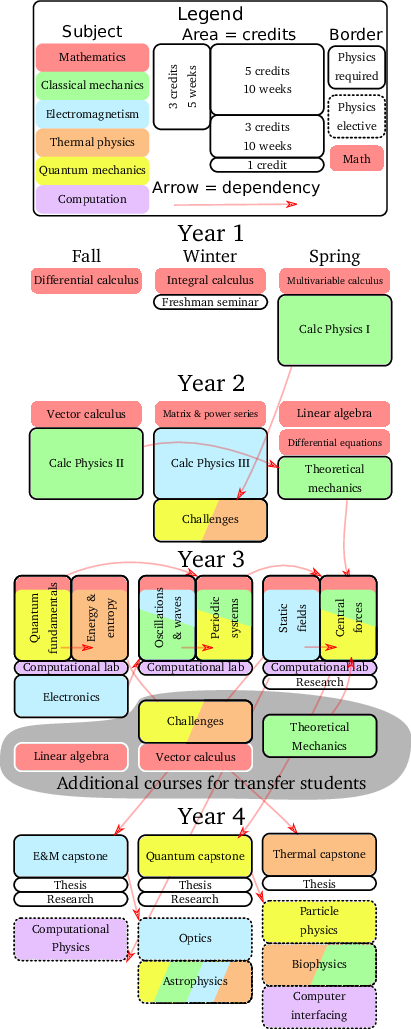
As a result of this process, we have implemented a number of changes to our physics major curriculum. The resulting curriculum is outlined in Figure 2.1. The changes consisted of introducing two new sophomore-level courses (which may be taken in the junior year) to better prepare our majors for the their junior year. We eliminated Modern Physics and the Classical Mechanics Capstone in favor of the two new sophomore-level courses. We eliminated the Math Methods course in favor of Math Bits integrated into the Paradigm courses. Finally, we restructured our nine 3-week Paradigm courses into six 5-week Paradigm courses. We changed our computational physics requirement, and reduced the number of electronics courses.
Subsubsection 5-week Paradigm courses
To begin with the most distinctive feature of our curriculum, we wanted to maintain the existing intensive 7-hour-per-week schedule in the junior year, which we have found effective. This schedule allows students to focus intensely on a single topic, it fosters the building of a cohort of students, and the daily schedule is helpful for active engagement. We chose to change from three 3-week courses per quarter to two 5-week courses per quarter. This gives students who fall behind a chance to catch up, and enables us to give more feedback to students prior to the final exam. Having 3-credit courses simplifies the setting of teaching loads, and by reducing the number of courses, we allow the curriculum to be taught with fewer faculty, albeit at an increased work load per professor.
We put considerable thought into the content and ordering of the new courses. In most cases, we think of each 5-week Paradigm course as either one formerly 4-week Paradigm course (the one that consumed the extra week each quarter), two 3-week courses compressed, or three 3-week courses combined into two 5-week paradigms. The major scheduling change is to place Static Fields (electrostatics and magnetostatics) in the spring quarter. This gives students, especially transfer students, a bit more time to take Vector Calculus. It also puts all use of curvilinear coordinates in the spring quarter, which should ease the learning of Central Forces. The final major change was to move special relativity from the junior year to the new sophomore-level Theoretical Mechanics course.
Subsubsection Math bits
Since Paradigms 1.0 was began, we introduced a math-intensive week preceding two of the Paradigm courses. These math weeks provided just-in-time preparation of the math skills required for those courses. We have found these math weeks to be effective and popular with students. In contrast to these weeks the Math Methods course is unwieldy, and challenging to place in the curriculum at a time where it is helpful to students. Moreover, some of the content in Math Methods was not actually required for our undergraduate courses, and only needed for students bound for graduate school. We chose therefore to eliminate the Math Methods course in favor of Math Bits consisting of a single week of just-in-time math content incorporated in each Paradigm course. Advanced students may also take our graduate-level Math Methods course. The Math Bits for the entire year is taught by a single professor, which provides continuity and coherence for the students. This provides some assistance for professors teaching Paradigm courses, and at the same time ensures that they do not succumb to the temptation to short-change the math content to the detriment of the students.
Subsubsection Electronics
We chose to reduce the Electronics requirement from two 3-credit courses to one 3-credit course. For many physics majors, this is more than sufficient, and gives students a greater number of electives. In addition, we removed the lecture section of this course—which had developed an unusually high student work load for a 3-credit course—in favor of in-lab instruction.
A final change to Electronics is that we now will require Electronics during the junior year (specifically as a prerequisite for Oscillations and Waves). This is made possible by the reduction in Fall workload for incoming transfer students, who had usually taken Electronics as a senior. This change has enabled us to articulate distinct and sequenced learning outcomes from these two courses, particularly in the realm of complex exponentials and Fourier transforms. It is also beneficial in providing students with trouble-shooting skills prior to the in-class labs taught in Oscillations and Waves.
Subsubsection Computational lab
Over the last six years, we have been developing a 1-credit computational laboratory course that accompanies the Paradigm courses. We chose to require this course, while removing a requirement for a lower-division 3-credit course in computational physics. This lower-division course was challenging to teach, since it always had a mix of lower- and upper-division students, with very different skill levels and needs. Transfer students now take computation alongside the non-transfer students. The course is taught in a laboratory setting using pair programming [26] to help new programmers to learn.
Subsubsection Sophomore courses
We introduced two new sophomore-level courses: Physics of Contemporary Challenges and Techniques of Theoretical Mechanics. Both of these courses ramp up student mathematical abilities prior to their junior year. The Challenges course focuses on estimation, dimensional reasoning, and interpretation of integrals, while Theoretical Mechanics teaches power series approximations and exposes students to increased levels of mathematical sophistication and sense-making strategies.
These courses have the challenge of teaching both juniors and sophomores together. They are taught in the winter and spring quarters, so as to reduce the burden on transfer students in the Fall. They were explicitly constructed to not teach any content required for Fall or Winter junior-year courses so that they can be taken concurrently with those courses.
Physics of Contemporary Challenges.
In this course we prepare students to apply physics concepts and physical reasoning skills to sustainable energy issues, climate change mechanisms, space exploration and puzzles in fundamental physics. These "real-world" topics are chosen for either the societal need (energy and climate), and/or the human need to explore (space and fundamental physics). By prioritizing inclusion of the most engaging challenges, we aim to attract and retain as many potential physics majors as possible [27].
While contemporary challenges determine the narrative flow of the course, physics concepts and physical reasoning skills are the main substance. Students are introduced to thermodynamics, statistical mechanics, electromagnetic radiation, quantum mechanics, and modern experimental physics—in each case motivated by one or more "contemporary challenges." Together with new physics concepts, students are given new reasoning tools, such as the equipartition theorem, the quantum-classical correspondence principle, order of magnitude calculations, simplifying assumptions, and numerical integration. Mathematically rigorous derivations are only briefly mentioned in class. Instead we emphasize the physics concepts and reasoning skills that allow professional physicists to quickly/quantitatively make an initial assessment of a complex problem.
Techniques of Theoretical Mechanics.
While the Challenges course takes a more experimental/applied physics focus, Theoretical Mechanics has a more theoretical physics flavor. The theme of this course is the discussion of strategies for making sense of physics problems and symbolic problem solving. This sense-making includes coordinating and interpreting symbolic expressions with conceptual understandings, geometric relationships, and physical intuitions.
This course is aimed at students who are taking or have completed the last course in the introductory sequence. The physics content of the course is advanced Newtonian mechanics, introduction to Lagrangian and Hamiltonian techniques, and special relativity. These topics are convenient for explicit discussion of sense-making strategies in physics because (a) these students have recently studied problems that serve as limiting cases for these more complex problems, (b) students at this level are transitioning from solving problems primarily involving numbers to problems with only symbolic parameters, and (c) sense-making as strategies can be discussed for approaching a problem, evaluating answers, and refining intuitions about relativistic and other unfamiliar situations. For example, we teach students how to use spacetime diagrams to develop a story about a relativistic situation and how to use hyperbola trigonometry on these diagrams to perform Lorentz transformations that can be checked against the results of algebraic Lorentz transformations. The sense-making goals of the course are on an equal footing with the physics goals, and sense-making is integrated explicitly in all aspects of the course: exams, homework and during in-class activities [28], [29]. Our aim is that students will develop sense-making skills that will improve their learning in advanced courses and will be valued by their upper-division course instructors, research advisors, and future employers.
Subsection Summary
We have developed a significant change to the Paradigms curriculum. This change focuses on the first two big ideas underlying the Paradigms project: (1) close attention to content ordering, and (2) developing a consensus and understanding of the curriculum among our faculty members. Our commitment to using active engagement in our upper-division curriculum remains unchanged. While the specific content ordering we developed may be interesting, the process by which we reached it and developed a faculty consensus is at the essence of what makes the Paradigms in Physics program distinctive. One of the authors (EvZ) have completed a retrospective study of the process we used to develop the original Paradigms program and we have used her results extensively in designing and implementing the Paradigms 2.0 process. She has continued to observe, study, and document our work as we have begun implementing the revised curriculum [30]. The process of developing faculty understanding of the Paradigms is ongoing, as we are having professors new to the department shadow experienced faculty as they teach Paradigm courses, prior to teaching the same course themselves.
Future work will involve documenting the learning trajectories that we have developed in our curriculum. Furthermore, we are engaging in a project to study our students’ development of sense-making skills in particular through the two new courses that are intended specifically to ramp up those skills.
We look forward to another two decades of the Paradigms!

